
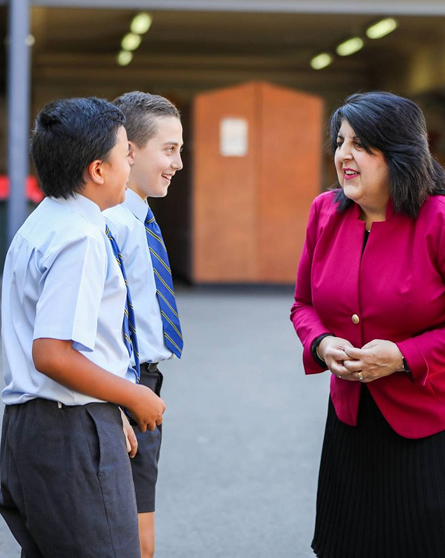

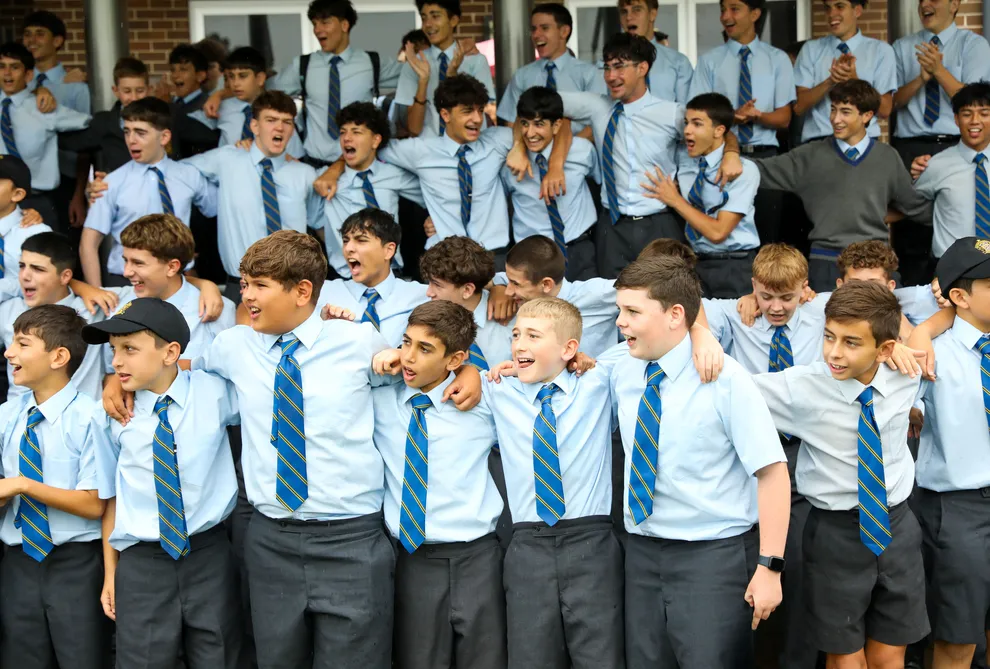
A healthy competitive environment allows students from different year groups to unite together for a common cause which in turn brings a sense of wellbeing, camaraderie and loyalty.
Ultimately when encouraged by their peers, students gain confidence and feel empowered to give their best. The system dates back to the 1930s when boys were placed into four coloured houses for the annual swimming and athletic carnivals; red, gold, green and blue.
During the 1970s the College expanded the four houses to six and named each after a significant person whose presence at the College had been pivotal to its evolvement; Br Berg, Br Coghlan, Br Crichton, Br Hanrahan, Br Hickey, and Fr Power (Parish Priest of St Martha’s). A further development was made in 1996 when on the beatification of Edmund Rice, Founder of the Christian Brothers, Power house was changed to Rice house.
In 2012 the College Cup was launched and redefined the way in which the house system is used at St Patrick’s College. To foster healthy competition amongst the boys, house points are awarded throughout the school year based on an individual’s efforts in areas of academic achievement, co-curricular involvement and school spirit. These are then tallied with the results from the swimming and athletic carnivals and a house is declared the overall winner.
After the successful implementation of the College Cup in 2012, the 2013 Prefect Leadership Team saw a need to highlight and develop a visual identity for each house in the form of a shield and motto. An extensive consultation process with students and staff, including a series of workshops, was embarked upon with the aim of encapsulating the identity and ethos of each house’s namesake. The resulting design and motto is an embodiment of ideas and choices made by the College Community while acknowledging the characteristics and values that underpin College life. In 2014 the Prefect Leadership body developed a prayer for each house reflecting the core values seen in the shields and mottos.
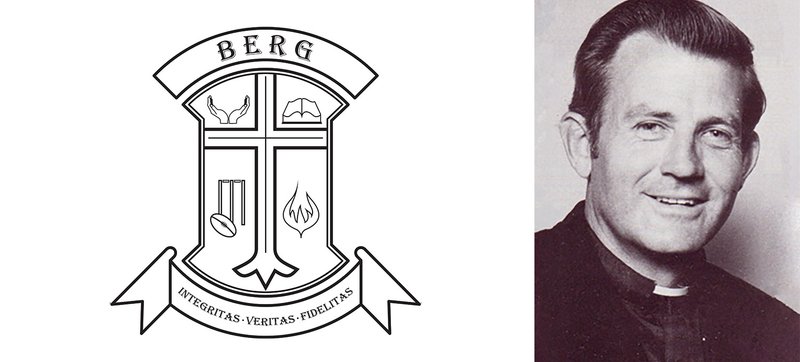
Berg Shield
The Hands: symbolise Br Berg’s commitment in the area of social justice, in particular his support of families and adolescents in crisis. They remind us that this is something we should strive to emulate.
The Book: represents Br Berg’s knowledge and passion for education, especially for the disengaged and marginalised youth.
The Cricket Stump and Rugby Ball: signifies Br Berg’s passion and commitment to sport and recognises his part in providing the students with an opportunity to represent their College in the blue, black and gold.
The Flame: like blessed Edmund Rice, Br Berg’s zeal in learning and his ability to ‘reach’ so many students, is represented by the flame taken from the Edmund Rice Icon.
The Cross: in the centre of the crest encompasses all of these symbols and represents Christ, who brings everything together.
PATRON
Berg House appropriately pays tribute to the values and contribution made to the College by Br Brian Berg, the first Old Student Brother to teach at St Patrick’s. Br Berg completed his Leaving Certificate at SPC in 1948 and entered into the Christian Brothers in 1950.
In 1961, after a spell of teaching in a number of country and city schools, Br Berg returned to his alma mater and was not only appointed as a teacher but also as College Sportsmaster. Later, in 1967, Br Berg was also appointed Deputy Principal of the College.
It was in his role of Sportsmaster that Br Berg initiated one of the biggest changes in the College’s history, a complete overhaul of the College’s sporting program. His belief in the value of sport as part of a student’s education was the impetus for this change as he wanted to give every student the opportunity to participate in a sport.
In order to implement these changes, SPC had to withdraw from the MCC competition, later becoming a founding member of the TCS (The Combined Schools). Competition took place on a Saturday, rather than a Thursday afternoon and instead of the boys playing League, we adopted the game of Rugby Union.
Having spent a total of 12 years at St Patrick’s College, Br Berg was posted to St Leo’s, Wahroonga as Principal in 1974, and then moved on to Waverley, SPC Goulburn and undertook another Principalship at St Dominic’s in Penrith. He has held the position of Deputy Provincial both in Strathfield and then Balmain, worked with marginalised youth in Mount Druitt and travelled to South Africa where he trained Youth Workers in Johannesburg and novices in Stellenbosch.
In 1998 Br Berg was presented with the St Patrick’s College Luceat Award in recognition of his success in life as a human being, a Catholic and a Christian Brother and in 2005 he was honoured with the award of Medal Order of Australia.
Berg House Prayer
God of Vigour and Vitality
Hear our prayer of gratitude, as we give thanks for the education and opportunities we are afforded.
Inspire us to integrity, truthfulness and loyalty, as demonstrated by Brother Berg.
Empower us to work for justice. Enable us to show support, compassion and generosity to families and adolescents in need.
May we emulate the example of Brother Berg by engaging in all academic, sporting and spiritual pursuits.
Lord, provide us with the strength and desire to be you for others.
In Your name we pray
Amen.
Integritas, Veritas, Fidelitas.
Live Jesus in our hearts forever.
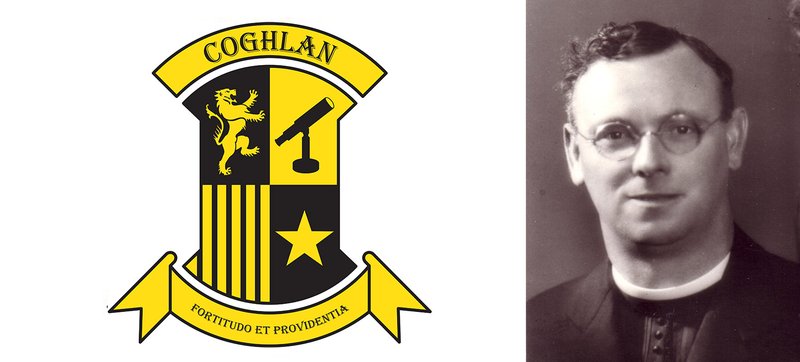
Coghlan Shield
The Lion: proudly striding forth represents the courage of Br Coghlan’s convictions, to make tough decisions in the face of adversity and to be brave when facing challenges.
The Telescope: symbolises Br Coghlan’s great vision and belief in the College’s potential. It also serves as a reminder to keep our sights set on the ideals of Blessed Edmund Rice as we embrace the future.
The Star and Bars: symbolise strength and fortitude and are taken from the College Crest, another Coghlan initiative. These together with his motto ‘Luceat Lux Vestra’ are embedded within the ethos of St Patrick’s College.
PATRON
Coghlan House honours the memory of Br John Vincent Coghlan, Headmaster of St Patrick’s College for two terms, 1936-1941 and 1945-1950. He played a leading role in developing the College’s identity and whilst he may not have laid the first stone, he introduced the strong foundations upon which the College has flourished.
br-coghlanJohn Vincent Coghlan was born in Brunswick, Victoria and educated at St Patrick’s College in Ballarat. He joined the Christian Brothers in 1909 and at the age of 16, came to Mount St Mary in Strathfield to commence his training. Following this, Br Coghlan undertook a number of different teaching and leadership roles in Sydney, Brisbane, Adelaide and Hobart, before being appointed Superior at Wagga Wagga. In 1936 however, Br Coghlan embarked on the first of his two appointments as Principal of St Patrick’s College, Strathfield.
From the onset Br Coghlan recognised the College’s great potential, but knew that if it were to be realised he would need to start with the students. One of his first challenges was to instil a sense of school spirit and pride within the students and with this in mind, Br Coghlan introduced the College crest, the College uniform and the College motto, Luceat Lux Vestra. He also appointed the College’s first student leadership team and even instructed one of the Brothers (Br Butler) to create a suitable war cry for our students to take to the sports field with. He also completed building projects like the tennis courts and was able to secure more land for the expansion of Breen Oval.
Under Br Coghlan’s leadership the ensuing years saw us enjoy some outstanding academic and sporting successes. People began to notice the smartness and politeness of the Christian gentlemen who came to the College, and as a result enrolments increased dramatically. Perhaps Br Coghlan’s greatest legacy however is our school spirit which has remained deeply engrained within the culture of St Patrick’s College.
Coghlan House Prayer
God of Strength and Wisdom,
Provide us with courage and vision in the face of adversity, to be a light for others, as modelled by Brother Coghlan
Gift us with the determination to build a better future, inclusive of all, especially the poor and the marginalised.
May we continue the legacy of school pride Brother Coghlan instilled within the College
Guide us, the students of Coghlan, to live these virtues in everything we do this day.
In Your name we pray.
Amen.
Fortitudo et Providentia.
Live Jesus in our hearts forever.
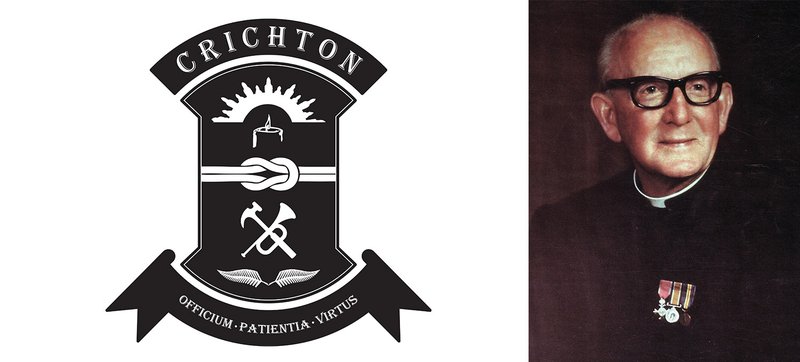
Crichton Shield
The Rising Sun and Candle: symbolises the light of the Rising Sun and the ANZAC spirit, this is illuminated by the flame of a candle signifying the light of Christ.
The Rope: a symbol of united strength, demonstrates the power of community. As a single strand we may be frail but when entwined with others, we are fortified.
The Bugle: which Digger Crichton famously used to entertain the troops, reminds us to be stoic in the face of adversity, to be leaders and not bystanders, and to stand up for our beliefs.
The Hammer: not only represents Br Crichton’s years as a dedicated teacher of woodwork, but also embodies the notion that even with the most basic tools, we have the power to build something great.
Silver Ferns: form the foundation of the shield and provide a symbol of Br Crichton’s early life and heritage in New Zealand. This connection to ancestry is strong within us all.
PATRON
Crichton House is named after Br John Rewi Crichton, who, for many years, was a devoted and much-loved teacher at St Patrick’s College.
John Crichton was born in New Zealand and following the death of his father, was brought up in an orphanage run by a French order of nuns known as the Sisters of Compassion. In 1908, at the tender age of 16, John Crichton left New Zealand in order to seek work in Sydney.
With the onset of World War I in 1914, John Crichton enlisted in the Australian Imperial Force which took him to places such as South Africa, Great Britain and France. During this time he was thrown into some of the heaviest fighting Anzac troops were engaged in and was decorated with seven medals of valour. During his time as a dispatch rider he famously witnessed the shooting down of the most celebrated German air ace, the Red Baron.
It wasn’t until after the war when John was working as a panel beater and cabinet maker in Melbourne, that a chance meeting with Br Hickey changed the course of his life. At the age of 30, the World War I veteran decided to pack up his tools and join the Christian Brothers in Strathfield. On the day the doors to the College opened in 1928, Br Crichton was one of only three Christian Brothers present and he remained here for the next 57 years teaching wood work, technical drawing and religion.
During his lifetime he had saluted King George V, met Pope John Paul II and received an M.B.E from Queen Elizabeth II. Upon his death, Br Crichton was the only Christian Brother to have been buried with an Australian flag draped over his coffin.
Crichton House Prayer
God of service,
Through Christ’s example of self-sacrifice on the cross,
Jesus taught us to persevere in adversity within our daily lives.
Following in the model of Brother Crichton, may we show resilience in the darkest of times.
Give us generous hearts of self- sacrifice and open our eyes to the adversity around us.
Teach us to emulate you in our every action
Make us men of service, resilience and valour.
In Your name we pray
Amen
Officium, Patientia, Virtus
Live Jesus in our hearts forever.
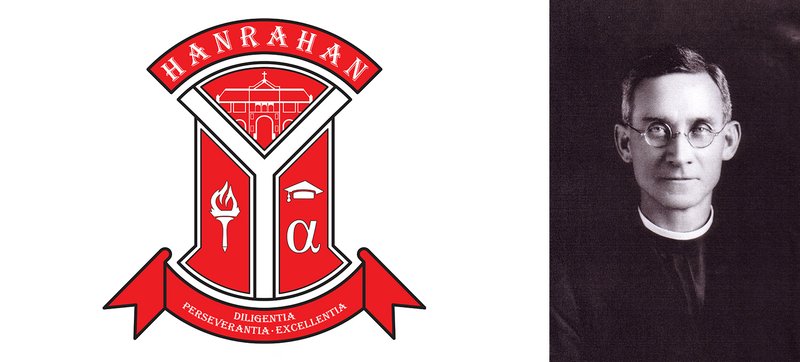
Hanrahan Shield
The Hickey Building: symbolises the foundation years of the College, and the original school building still standing proudly within the College today.
The Mortar Board: encapsulates Br Hanrahan’s love of learning and the fact that he was a keen academic. It also reminds us that with knowledge we have the power to be the best we can be.
The Alpha Symbol: the first letter in the Greek alphabet, recognises Br Hanrahan’s love of Greek philosophy and his place at the beginning of our College’s history.
The Flame: since Br Hanrahan was a keen advocate of sport, the significance of the flame is twofold. Firstly, it embodies what we should strive to achieve in all our endeavours, sporting or otherwise: excellence, respect and friendship – the Olympic ideals. It also represents the light of Christ, as we reflect on the work of the Christian Brothers, both past and present, who continue in the mission of our Founder, Blessed Edmund Rice.
The Spartan Helmet: when the symbols are removed from the Hanrahan shield, an image of a Spartan helmet remains illustrating unity and a formidable force.
PATRON
Hanrahan House recognises the efforts of an outstanding educationist by the name of Br Michael Benignus Hanrahan. As the first Headmaster of St Patrick’s College he led the school from 1928 to 1929.
Michael Benignus Hanrahan was born in New Zealand and attended the local Catholic Primary school where he was a ‘star pupil’. Upon completion of his education, Michael Hanrahan joined the Christian Brothers at the age of 16 and came to Sydney to begin his training as a teacher.
Following a brilliant University career and having taught in numerous schools in NSW, Queensland and WA, Br Hanrahan was transferred back to Sydney where he was appointed the first ‘Master of Method’ at the Mount St Mary Training College in Strathfield. His obvious flair as an educationalist had him involved in teacher training for the next 40 years.
In 1920, Br Hanrahan became a member of the governing council of the Christian Brothers of Australia, and from 1930-1942 the Provincial Leader. In this role he saw the establishment of 17 new Christian Brothers schools around Australia and New Zealand, one of which was St Patrick’s College, Strathfield.
Br Hanrahan was by all accounts a philosopher. In particular he was a big fan of Aristotle and would often apply his deep knowledge and interest in all matters of the mind to his classroom technique. He was an enterprising seeker of knowledge who, by his own description, was determined to be ‘a picker up of learning’s crumbs’. Not only a fine scholar, his tall athletic figure would often be seen on the cricket field or on the courts partaking in a vigorous game of handball! After he officially retired in 1943, Br Hanrahan regularly came down to St Patrick’s to teach a Religious Education Class.
Hanrahan House Prayer
God of Light and Truth,
You are the beginning and end of all things.
Help us this day to strive for excellence in all that we do, replicating the love for learning displayed by Brother Hanrahan.
Ensure that we treat those within our community with respect and integrity at all times.
Give us the grace to be united in the bonds of friendship and solidarity, so that we may reflect the light of Christ and walk in the radiance of your love.
Guide us, the students of Hanrahan, to embody the values of hard work, perseverance and excellence.
In Your name we pray
Amen.
Diligentia, Perseverantia, Excellentia.
Live Jesus in our hearts forever.
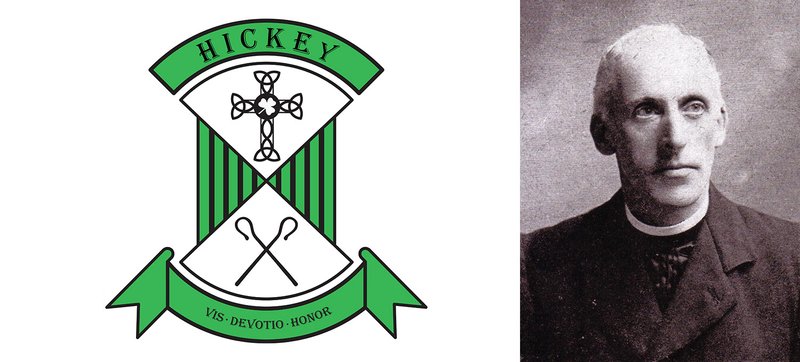
Hickey Shield
The Bars and Chevrons: recognise Br Hickey’s efforts in establishing the solid pillars of the College’s foundation and the strength from which it has grown. The word chevron is a French term for roof, an overarching structure that provides us with protection and unity.
The Celtic Cross: epitomises the essence of Br Hickey, and his devotion to the Christian Brothers.
The Shamrock: in the heart of the cross represents both Br Hickey’s Irish heritage and also that of our Founder, Blessed Edmund Rice.
The Shepherd Staffs: refers to Br Hickey’s ability to recruit suitable young men into the Brotherhood of the Christian Brothers, he was one of ‘God’s Shepherds.’
PATRON
Hickey House honours a man who holds a significant place in the College’s history. In fact without the vision of Br Patrick Ignatius Hickey; St Patrick’s College would not exist today.
Patrick Hickey was born and grew up in Athy, Ireland subsequently becoming its first Catholic Town Clerk at the tender age of 16. This appointment he retained until at age 19, when he decided to join the Christian Brothers. For almost 40 years Br Hickey taught in various schools in Ireland before being summoned to Australia in 1920, in order to fill a vacancy in the Executive Council of Brothers here.
One of the first challenges Br Hickey undertook in this new role was to seek out a supply of Brothers to staff the existing schools within the Australasian Province. He was so successful at finding young men who would be suited to this vocation, many felt he was directed and guided by the Spirit of God Himself.
In 1925, Br Hickey was promoted to the office of Provincial Superior which presented the opportunity to further develop his plans for the welfare of the Province. One such project was the erection of a ‘Practising School’ at Strathfield to coincide with the Teacher Training College at Mount St Mary. And so the building operations of St Patrick’s College began and were overseen on a daily basis by the visionary Br Hickey.
Sadly however in 1927, due to ill health Br Hickey resigned as Provincial and travelled back to his beloved Ireland and then on to Bath in England where he was eventually laid to rest. This meant that he didn’t get to see one of his greatest legacies, St Patrick’s College, in all of its glory.
Hickey House Prayer
God of eternal life and hope.
With courage and perseverance, Brother Hickey answered the call to grow the Christian Brothers and lay the solid foundations of our College.
Instil within us strength, to be leaders and stand for what is right and just.
Lord, give us the dedication to wholeheartedly engage in all aspects of life and to be men of conviction and vision.
Help us exhibit respect, allowing us to celebrate the gifts of people from all walks of life.
May the road rise up to meet us,
May the wind be at our back,
May we always walk in the footsteps of Brother Hickey's track.
In Your name we pray.
Amen.
Vis, Devotiot, Honor.
Live Jesus in our hearts forever.
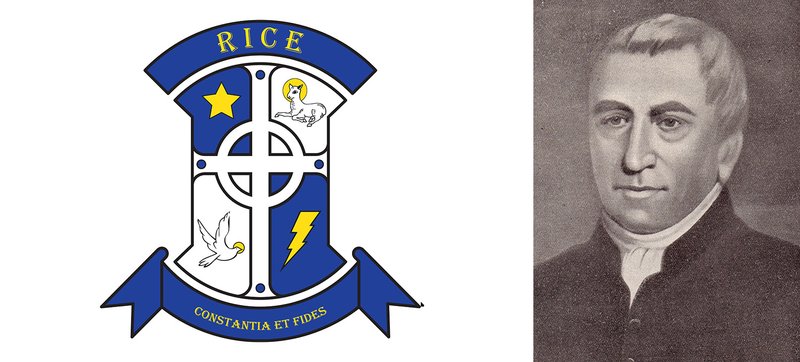
Rice Shield
The Star: signifies the lighting of our way to knowledge and the Heavenly Father.
The Lamb: taken from the Edmund Rice Icon, it symbolises the Lamb of God, Jesus Christ.
The Dove: reminds us that Blessed Edmund Rice was gifted by the Holy Spirit, just as we sing in the Edmund Rice anthem.
The Lightning Bolt: not only recognises the fact that Rice house was originally named Power House, after the former Parish Priest of Strathfield, but also serves to remind us that when we put our energies together we are a powerful force.
The Celtic Cross: at the heart of the crest not only symbolises the origins of Blessed Edmund Rice and his congregation of Christian Brothers, but above all Christ, who lives in our hearts forever.
PATRON
Rice house pays tribute to our Founder, Blessed Edmund Rice, an exceptional human being who dedicated his life to God and the education of the poor and marginalised students in Ireland.
Edmund Rice was born in Callan, Ireland to a farming family. At the age of 17, Edmund joined his uncle in a shipping supply business in the busy city of Waterford, which subsequently grew and prospered. After some years Edmund met Mary Elliott whom he fell in love with and later married. However this happiness was short lived as sadly only 2 years later she died, leaving him an invalid daughter, for whom he cared lovingly throughout his life.
It was at this time that Edmund became even more sensitive to the plight of the poor and upon joining a spiritual association of men in Waterford, grew increasingly uneasy with the wealth he was acquiring through his business. Edmund felt that God was calling for him to make a change in his life and so he decided to do something about the poor neglected boys of Waterford and their desperate need for education. In 1802, at the age of 40, Edmund Rice turned a disused stable into his first small school, moving the following year to the monastery and school he built at Mount Sion.
Edmund faced many challenges in his mission, not least of which was to find staff to teach such ‘unruly’ boys. However it wasn’t long before word spread of this courageous enterprise and in 1808, with six companions who had come to join him, he pronounced his vows as religious. In Edmund’s lifetime his congregation of Christian Brothers spread throughout Ireland and on to other corners of the globe, reaching Australia in 1843.
Today his mission is continued in over four hundred foundations in twenty-two countries. St Patrick’s College, Strathfield stands proudly as an inheritor of the charism of Edmund Rice and the Christian Brothers who came to teach here. Edmund Rice was beatified on October 6, 1996 in Vatican City by Pope John Paul II.
Rice House Prayer
God of life and love,
We look to Blessed Edmund Rice as a model of sacrifice and compassion, working for those who lived on the margins.
As we grow in faith, help us to recognise the opportunities presented to us and enable us to share these blessings with others.
Allow us to see the potential in one-another and the unique gifts that we share.
Together as a team we pursue success through your gifts of effort and determination, placing our trust in you.
In Your name we pray.
Amen
Constantia et Fides
Live Jesus in our hearts forever.
Keep exploring
Our Identity
St Patrick’s College shapes young men of character, faith and purpose. Students are encouraged to develop a strong sense of identity, responsibility and service.

Begin your journey and let your light shine
Every boy who walks through our gates begins a journey shaped by faith, friendship and challenge. This is where confidence grows, talents emerge and young men learn to live with purpose and heart.